
Benjamin L. Stewart’s Language Teaching Commons
Teaching • Research • Teacher Education
Making teaching and learning more transparent.
Welcome to my Language Teaching Commons—a public space where I share course materials, teaching resources, research ideas, and reflections from my work as an English language teacher educator.
Where would you like to go?
Students: Find your current course below.
Visitors: Explore my work in language teaching, teacher education, writing, discourse, and AI.
Current Courses
🎓 Academic Writing
Research, evidence, academic writing, and scholarly communication.
🔎 Discourse Analysis
Explore how language works in context through cohesion, information structure, discourse patterns, and authentic language use.
🎧 Listening I
Develop listening comprehension through authentic and adapted spoken English, collaborative activities, and purposeful listening strategies.
✍️ Writing I
Build a foundation for clear and effective written English through sentences, paragraphs, organization, and meaningful communication.
📚 Previous Courses
Looking for materials from an earlier semester?
Browse previous course sites, modules, activities, assignments, and teaching resources in the Course Archive →.
Helping language teachers notice, decide, assess, and adapt.
Developing Language Teachers for a Changing Profession
Much of my current work centers on a question that is becoming increasingly important:
What will language teachers need to know and be able to do in a profession increasingly shaped by artificial intelligence?
I believe the answer involves more than learning how to use AI tools.
Teachers need to develop the professional judgment that allows them to understand learners, make principled teaching decisions, recognize genuine evidence of learning, and adapt responsibly as technologies and educational contexts change.
I organize this development around four interconnected capacities:
Notice → Decide → Assess → Adapt
👁️ Notice — Professional Vision
Learn to see what matters.
Effective teaching begins with noticing.
Teachers need to learn how to read learners, classroom interactions, language use, participation, difficulties, and emerging evidence of understanding.
Professional vision means moving beyond simply following a lesson plan and becoming increasingly capable of recognizing what is actually happening during learning.
Questions I explore include:
- What should teachers notice about learners?
- How can classroom evidence inform teaching?
- What can discourse reveal about learning and participation?
- How does experience change what teachers are able to see?
Professional vision turns classroom experience into evidence.
🧭 Decide — Pedagogical Decision Making
Make principled choices about teaching and learning.
Teaching involves hundreds of decisions: what to teach, how to teach it, what materials to use, when to intervene, when to allow productive struggle, and when to change direction.
Developing teachers need more than techniques. They need the ability to connect instructional decisions to learners, purposes, evidence, theory, and context.
Questions I explore include:
- Why choose one activity rather than another?
- How should learning objectives shape instruction?
- When should teachers adapt a lesson?
- What should teachers delegate to technology?
- What decisions require professional human judgment?
Good teaching is not simply following a method. It is learning to make defensible decisions.
🔎 Assess — Assessment Literacy
Look for evidence that learning has actually occurred.
Assessment is more than assigning grades.
The growing availability of generative AI makes an old educational question even more important:
What evidence demonstrates that the learner—not simply the tool—has learned?
Assessment-literate teachers design opportunities to observe learning, interpret evidence, provide feedback, and make decisions about what should happen next.
Questions I explore include:
- What counts as evidence of learning?
- How can formative assessment improve instruction?
- How should assessment change when learners use AI?
- How can teachers distinguish performance from learning?
- How can assessment support learner ownership?
Assessment connects what we hoped learners would learn with evidence of what they can actually understand and do.
🔄 Adapt — AI Adaptability
Learn how to keep learning as the profession changes.
AI adaptability is not simply knowing the latest tools.
Tools will change.
The more durable capability is learning how to evaluate new technologies, determine what they can contribute, recognize what they cannot replace, and continually reconsider one’s own professional practice.
Questions I explore include:
- What should teachers delegate to AI?
- What should remain human?
- How can AI extend rather than replace teacher judgment?
- How can teachers preserve learner agency and intellectual ownership?
- What professional capabilities become more valuable as AI improves?
- How can teachers prepare for changes we cannot yet predict?
The goal is not to compete with AI. It is to become increasingly capable of doing the professional work for which human judgment matters most.
A Cycle of Teacher Development
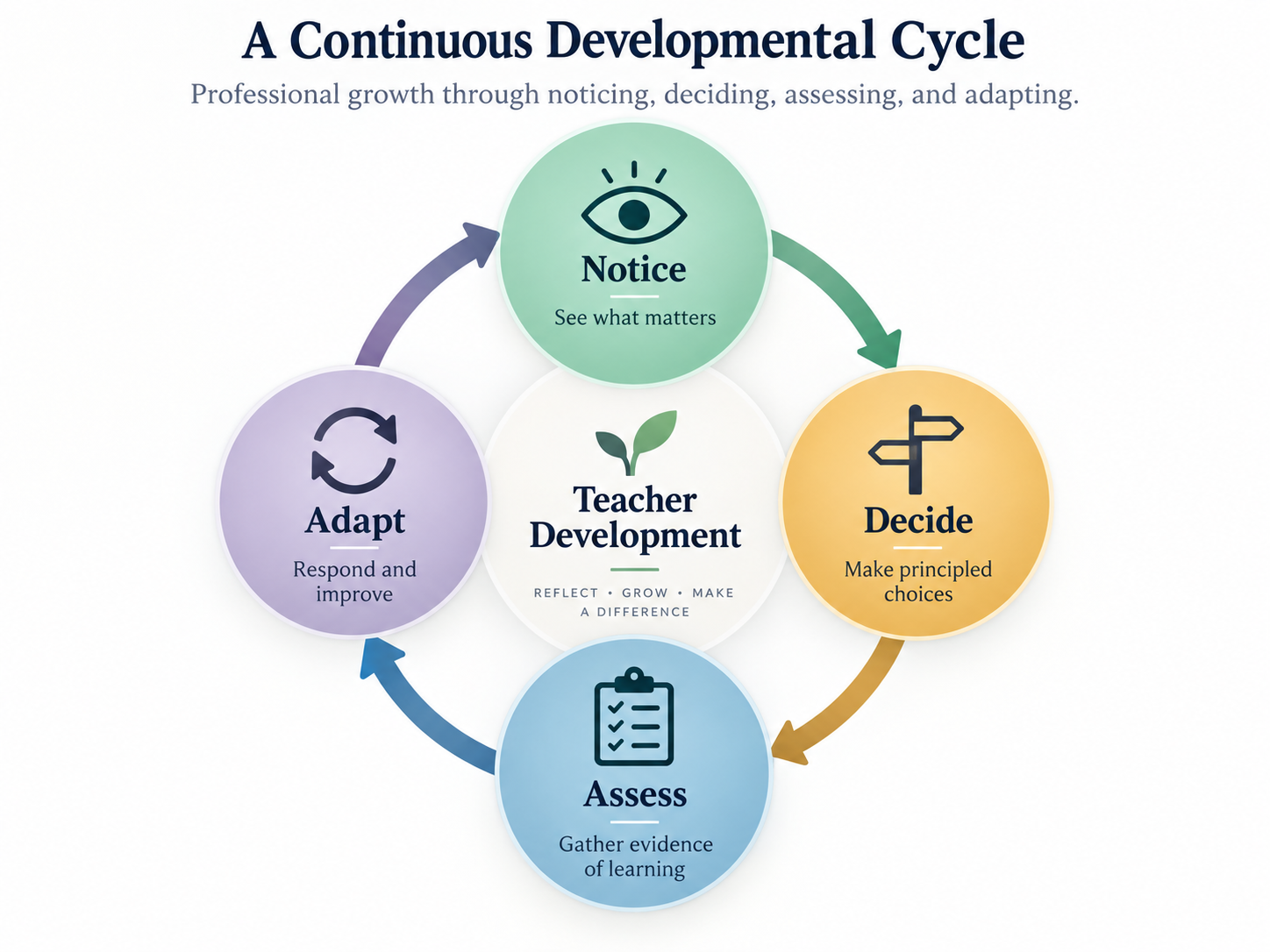
These four capacities form a continuous developmental cycle:
NOTICE what is happening
↓
DECIDE what teaching response is appropriate
↓
ASSESS what learners actually understand and can do
↓
ADAPT instruction, tools, and professional practice
↓
NOTICE again
Teacher development is therefore less about accumulating techniques and more about progressively improving professional judgment.
The resources in this Commons document my own continuing work within that cycle.
About Benjamin
I am an English language teacher educator and professor at the Universidad Autónoma de Aguascalientes in Mexico.
My work focuses increasingly on helping current and future language teachers develop the professional judgment they will need in a changing educational landscape.
I organize much of that work around four capacities:
Notice. Decide. Assess. Adapt.
That means learning to notice meaningful evidence, make principled pedagogical decisions, assess genuine learning, and adapt thoughtfully as technologies such as generative AI change what teachers and learners can do.
This site is a public record of that work. It brings together course materials, teaching resources, research ideas, experiments, and reflections from practice.
Elsewhere
You can also follow my longer-form writing and professional work online.
-
Substack — essays, reflections, and longer-form writing
-
LinkedIn — professional updates and shorter-form ideas
-
GitHub — public projects and the technical side of this site
Quote
Language Teaching Commons
Teaching, research, and resources for language educators.